

For many HR teams in Singapore, the end of the year isn’t a time to wind down – it’s when everything peaks at once. While other departments wrap up their final deliverables, HR is closing performance reviews, finalising payroll adjustments, updating policies, preparing for audits, and rewriting job descriptions for the new year.
Before they even recover, January arrives with another surge of demands: onboarding cycles, leave resets, new compliance rules, and urgent hiring needs. What should feel like a fresh start often becomes a continuation of the same relentless pace.
It’s no surprise that HR begins the year already exhausted. Yet leaders often view HR through a different lens, saying: “HR needs to be more strategic.” But the real issue isn’t capability – it’s capacity. HR isn’t underperforming. HR is overwhelmed, buried under manual processes that leave little room for higher-value work.
HR isn’t unskilled — they’re buried

Step inside any SME’s HR department and the reality becomes clear. HR professionals spend most of their day answering repetitive enquiries, digging up old policies, chasing incomplete forms, updating spreadsheets, and stitching information together across multiple disconnected systems.
They know exactly what strategic HR should look like: improving workforce planning, strengthening culture, supporting managers, refining hiring processes, and enabling long-term development. But the day-to-day operational noise leaves little room for this work.
Every day brings another set of small fires – missing documents, unclear claims, urgent letters, late reviews, last-minute audit requests. None of these tasks are difficult individually, but in volume, they push HR into constant firefighting mode.
And each year, the workload quietly increases.
Why HR Workloads Keep Rising Year After Year

Compliance expectations have expanded. Employees expect fast, clear answers. Managers rely on HR for guidance in areas that used to be handled independently. Internal systems multiply, but integration still lags behind. HR becomes the “human connector” between tools, people, and processes.
Communication has also become more fragmented. Employees now reach HR across multiple channels – email, WhatsApp, Teams, calls, and even personal messages. Each channel increases convenience but adds administrative weight to HR’s day.
All these factors accumulate into a silent productivity crisis: HR works harder, yet impact appears unchanged.
The Hidden Cost of Operational Bottlenecks

The effect of HR overload doesn’t appear in a P&L line, but it shows up across the organisation.
❌Hiring becomes reactive instead of strategic
❌Job descriptions are recycled. Candidate screening becomes rushed
❌Communication is slower
➜ The result is poorer hiring quality and weaker probation outcomes. Policies start to lose consistency, and when outdated documents continue circulating, employees receive conflicting interpretations – leading to confusion and a growing sense of unfairness.
Performance and development conversations also begin to lose depth. Managers rush through forms, feedback becomes superficial, and development plans are forgotten as soon as the review cycle ends. Over time, this erodes employee engagement and trust.
And behind all this is a very real human cost: HR burnout. Most HR professionals enter the field to support people and shape culture – not to spend their days chasing forms and fixing admin gaps. When their role becomes dominated by operational noise, morale declines, and strong HR talent eventually moves on.
⚠️What HR Should Look Like & Why They Can’t Get There Today
In an ideal world, HR teams spend their time building organisational capability. They shape recruitment strategies, coach managers, drive culture, and implement development programmes that improve retention and performance.
But this ideal never becomes reality if operational load continues to dominate their week. To unlock HR’s strategic potential, repetitive work must be delegated – not to more humans, but to automation.
How Automation Frees HR From Admin Firefighting
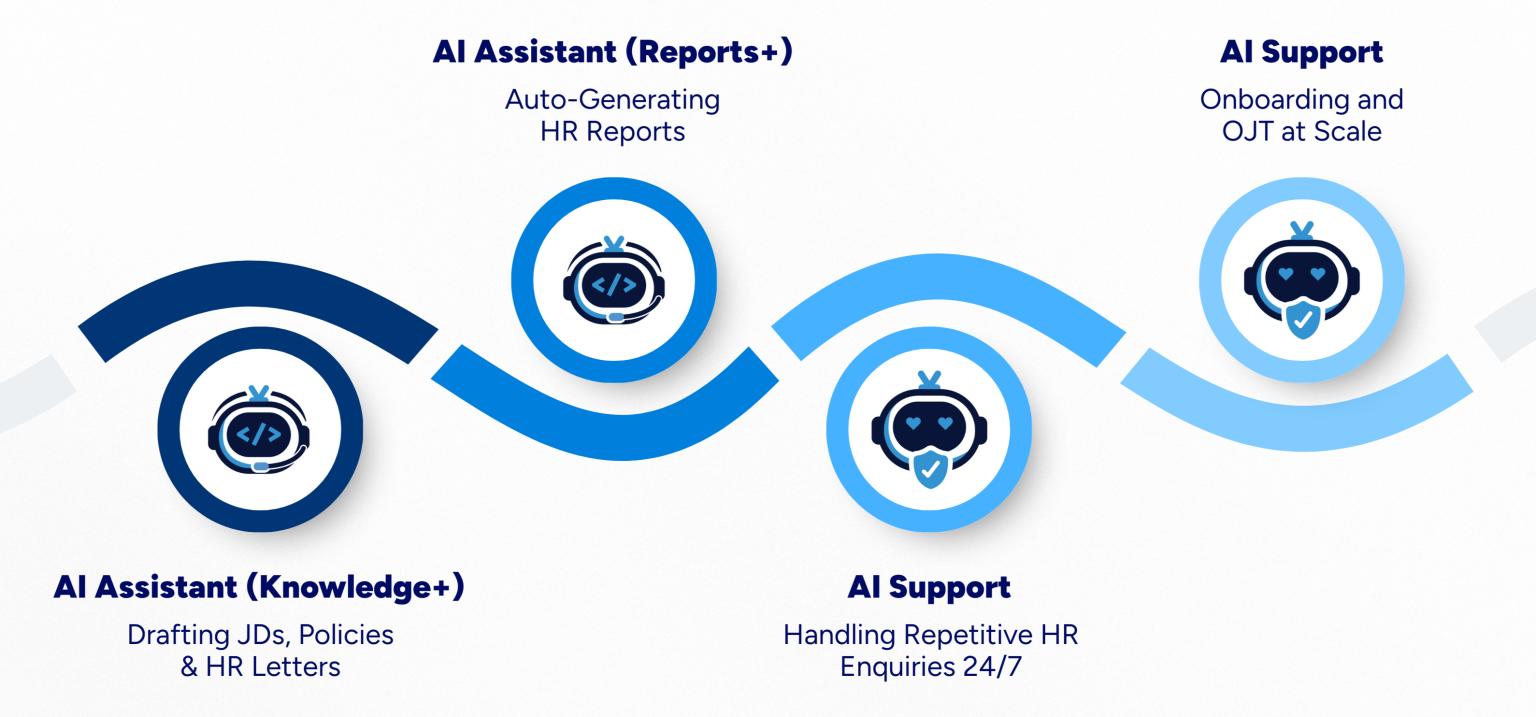
Modern HR automation isn’t designed to replace the HR team. It’s built to operate like a set of digital colleagues – quietly taking on the repetitive, operational tasks that drain hours from HR every week. When these tasks are automated, HR finally regains the space to focus on judgment, relationships, and real strategic work. In practice, this is how AI-powered HR assistants reshape everyday HR operations:
1.AI Assistant (Knowledge+) – Drafting JDs, Policies & HR Letters
Instead of starting every document from scratch, HR can rely on an AI assistant that understands the organisation’s structure and requirements.
With AI Assistant (Knowledge+), HR can quickly:
✅Draft job descriptions based on role, level, and department
✅Generate HR letters ➜ offer, confirmation, promotion, warning, etc. – aligned with MOM guidelines
✅Standardise policy language so documents remain consistent across the company
HR still reviews and approves everything, but the heavy drafting workload is removed. What used to take an hour now takes minutes.
2.AI Assistant (Reports+) – Auto-Generating HR Reports
Reporting is one of HR’s most time-consuming responsibilities. Monthly and quarterly cycles demand headcount updates, turnover analysis, leave utilisation summaries, training data, and probation outcomes – usually compiled manually.
With AI Assistant (Reports+), HR can:
✅Pull relevant data from existing systems or spreadsheets
✅Generate structured reports using predefined templates
✅Include summaries, highlights, and actionable recommendations
The workload shifts from report creation to report interpretation, where HR adds far more value.
3.AI Support — Handling Repetitive HR Enquiries 24/7
Most HR enquiries are predictable and repetitive:
🗣️“How many days of leave do I have left?”
🗣️“What is the claim policy for this?”
🗣️“Where is the staff handbook?”
🗣️“What’s the process if I want to resign or change roles?”
AI Support functions as an always-on HR helpdesk that can:
✅Answer leave, claims, and policy questions instantly
✅Direct employees to the correct forms or portals
✅Escalate sensitive or complex cases to HR only when needed
Employees receive immediate clarity. HR’s inbox finally breathes.
4.Employee Training & Support – Onboarding and OJT at Scale
New employees frequently need guidance, and every question often lands with HR or a busy manager:
🗣️“What should I do in my first week?”
🗣️“How do I use this system?”
🗣️“What’s expected in my role?”
With AI Support – powered onboarding and OJT processes:
✅New hires can access onboarding guides, FAQs, and workflow explanations anytime
✅Role-specific tasks and policies can be explained by an AI assistant as employees work
✅HR no longer needs to repeat the same instructions for every new joiner
Onboarding becomes consistent, scalable, and far less dependent on HR’s availability.
The ROI of an AI-Enabled HR Function

The benefits of automation aren’t theoretical – they are felt immediately across the organisation. HR can reclaim over 70% of the time previously spent on repetitive administrative tasks, giving the team the bandwidth to refine hiring processes, strengthen compliance, and improve the consistency and fairness of reviews. Employee experience becomes noticeably better as answers become faster, clearer, and more reliable.
Managers receive stronger day-to-day support, employees feel more empowered and informed, and leadership gains meaningful visibility into workforce risks and emerging trends.
Most importantly, HR is no longer a department buried under manual work – it transforms into a true strategic partner that drives culture, capability, and organisational growth.
Upgrade Your HR Operations Today!
Year-end is the moment when HR reflects on what worked and what didn’t. It’s also when leaders set budgets, hiring plans, and organisational priorities for the upcoming year. If HR enters 2026 with the same constraints, nothing will change.
Vision’s HR-focused AI tools are built to help HR teams operate at a higher level by:
✅Freeing HR from repetitive admin so they can focus on strategic work
✅Improving hiring quality and reducing time-to-hire
✅Standardising HR documents, JDs, policies, and performance reviews
✅Delivering consistent onboarding and training at scale
✅Giving leaders better visibility into workforce risks and trends
This isn’t about replacing HR. It’s about giving HR the time and tools they need to lead, not just survive.
Because HR deserves better than paperwork and organisations deserve an HR function that can build the future, not just handle the present.