

As AI adoption accelerates across enterprises, expectations are high. Leaders expect AI to improve efficiency, reduce cost, and support better decisions. Yet in practice, many AI initiatives struggle to move beyond pilots or deliver consistent results.
The reason is simple: AI does not fail because the technology is weak. AI fails because organisations deploy it without the right data controls, governance, cost structure, and adoption strategy.
According to research and industry analysis from Eaton Business School, enterprises face a growing list of AI challenges heading into 2026. These challenges go far beyond model performance or innovation speed and instead focus on data quality, trust, cost, explainability, and adoption.
While there are many AI challenges organisations must navigate, this article focuses on five of the most common and impactful challenges seen across industries today and how VisionGroup addresses them through practical, workflow-driven AI solutions designed for real business environments.
1. Inconsistent Data Leads to Inaccurate AI Responses
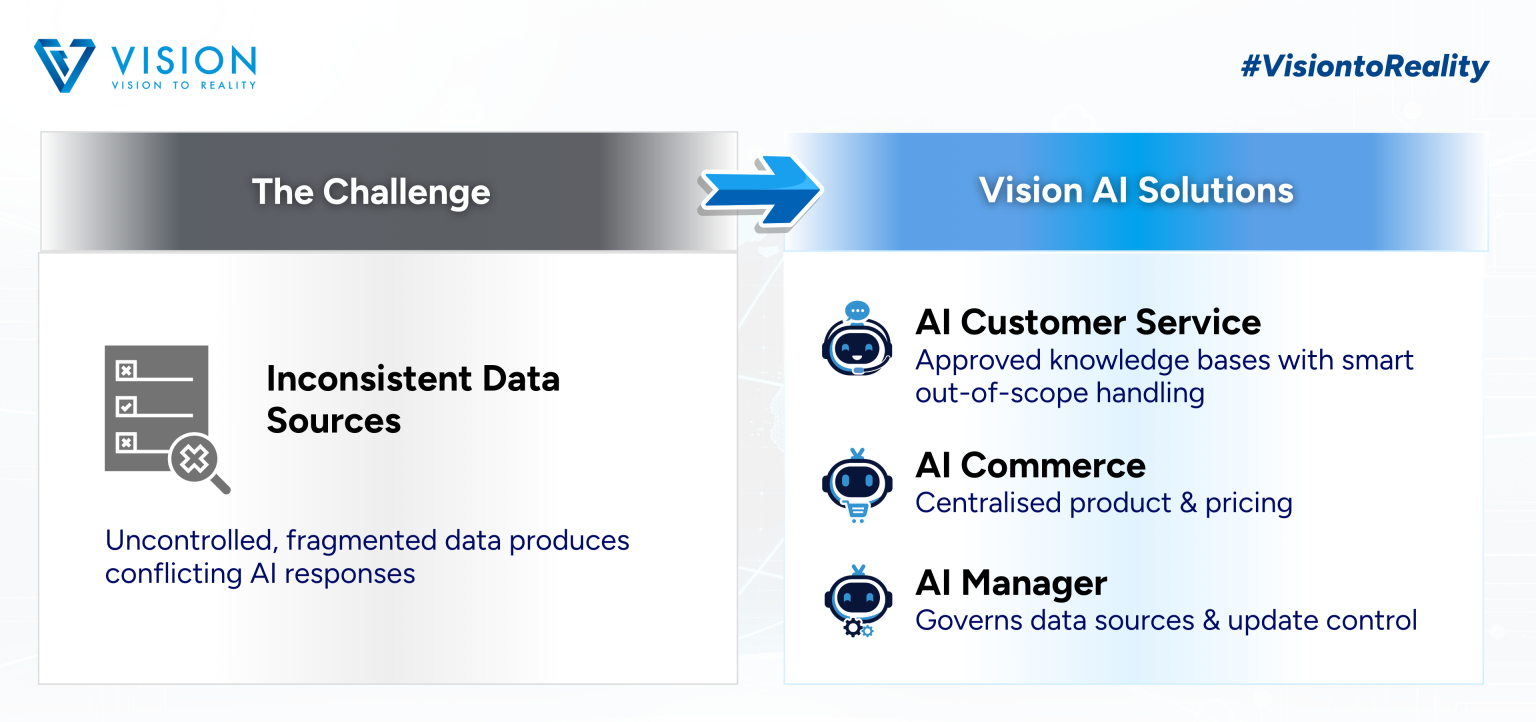
Most enterprise data environments did not evolve with AI in mind. Product information lives in one system, policies in another, pricing in spreadsheets, and FAQs in documents maintained by different teams. Over time, versions drift and ownership becomes unclear.
🌐How VisionGroup addresses this
VisionGroup designs AI systems to operate only on controlled and verified data:
✅AI Customer Service uses approved knowledge bases with smart out-of-scope handling
✅AI Commerce centralises product, pricing, promotion, and inventory data
✅AI Manager governs data sources, update cycles, and AI rules from one control layer
💡Why this works
These Vision solutions do not invent or infer information. They rely on data the business owns, approves, and maintains. As a result, AI responses remain accurate, consistent, and safe – creating a stable foundation for all other AI use cases.
With data reliability in place, organisations can then focus on a second, equally dangerous risk: AI saying the wrong thing with confidence.
2. AI Hallucinations Cause Wrong Promises to Customers
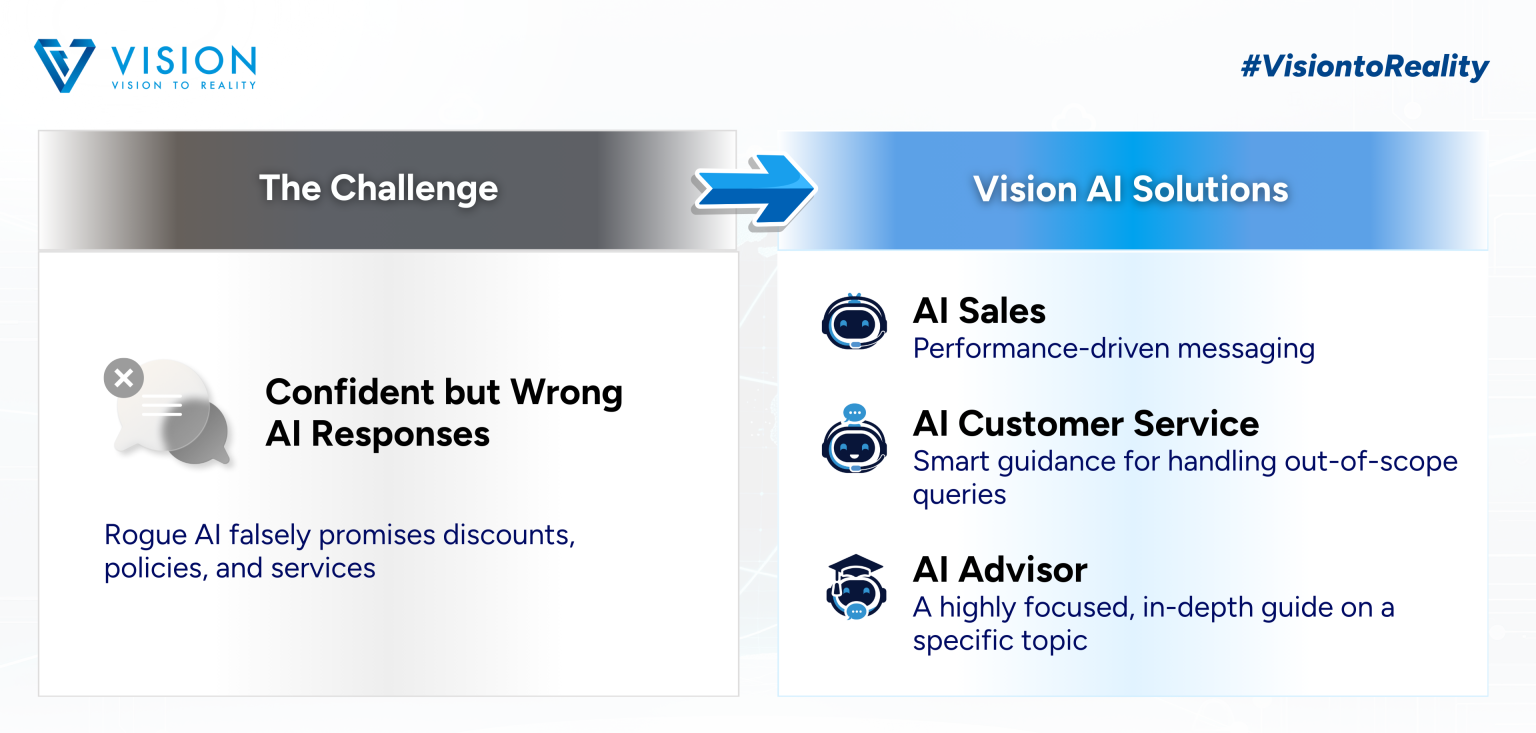
One of the fastest ways to lose trust in AI is when it sounds confident but delivers the wrong answer. Many organisations experience AI promising discounts, policies, or services that do not exist. Sales teams must then manage expectations, while service teams clean up the fallout.
This problem rarely comes from bad intent. It comes from AI systems that are allowed to generate freely without clear boundaries.
🌐How VisionGroup addresses this
VisionGroup limits AI behaviour through structured, rule-based workflows:
✅AI Sales optimizes messaging with real-time performance data
✅AI Customer Service provides smart guidance for handling out-of-scope queries
✅AI Advisor delivers an in-depth guide focused on a specific topic
💡Why this works
These Vision solutions assist conversations without improvising facts. By design, AI supports teams without making unapproved commitments. This keeps customer communication accurate and protects the brand.
Once organisations trust what AI says, the next question becomes more strategic: can we trust why AI makes a recommendation?
3. AI Decisions Cannot Be Explained or Defended
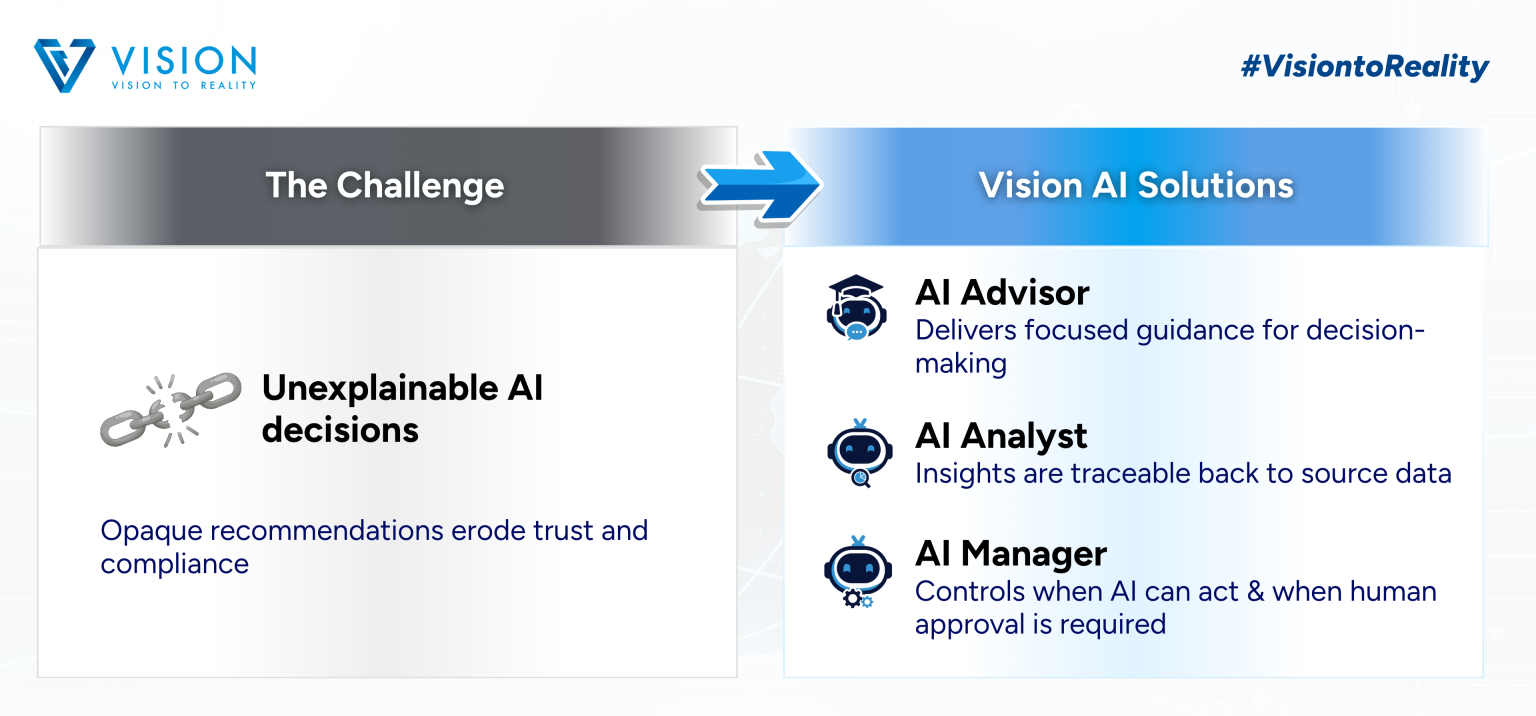
As AI begins to influence decisions, executives and compliance teams naturally ask tougher questions – why the AI recommended a specific option, what data it relied on, and who remains accountable if the decision turns out to be wrong.
If these questions cannot be answered clearly, AI quickly loses approval, especially in regulated or high-stakes environments.
🌐How VisionGroup addresses this
VisionGroup treats AI as decision support, not decision replacement:
✅AI Advisor delivers focused guidance for decision-making
✅AI Analyst produces insights that trace back to source data
✅AI Manager controls when AI can act and when human approval is required, using sentiment analysis to identify sensitive or high-risk situations.
💡Why this works
These Vision solutions create clarity, not opacity. Decisions remain explainable, traceable, and defensible. This allows AI to operate within governance frameworks rather than outside them.
Even with trust and transparency, many organisations face another hard reality: AI costs spiral before value appears.
4. AI Is Expensive and Never Scales
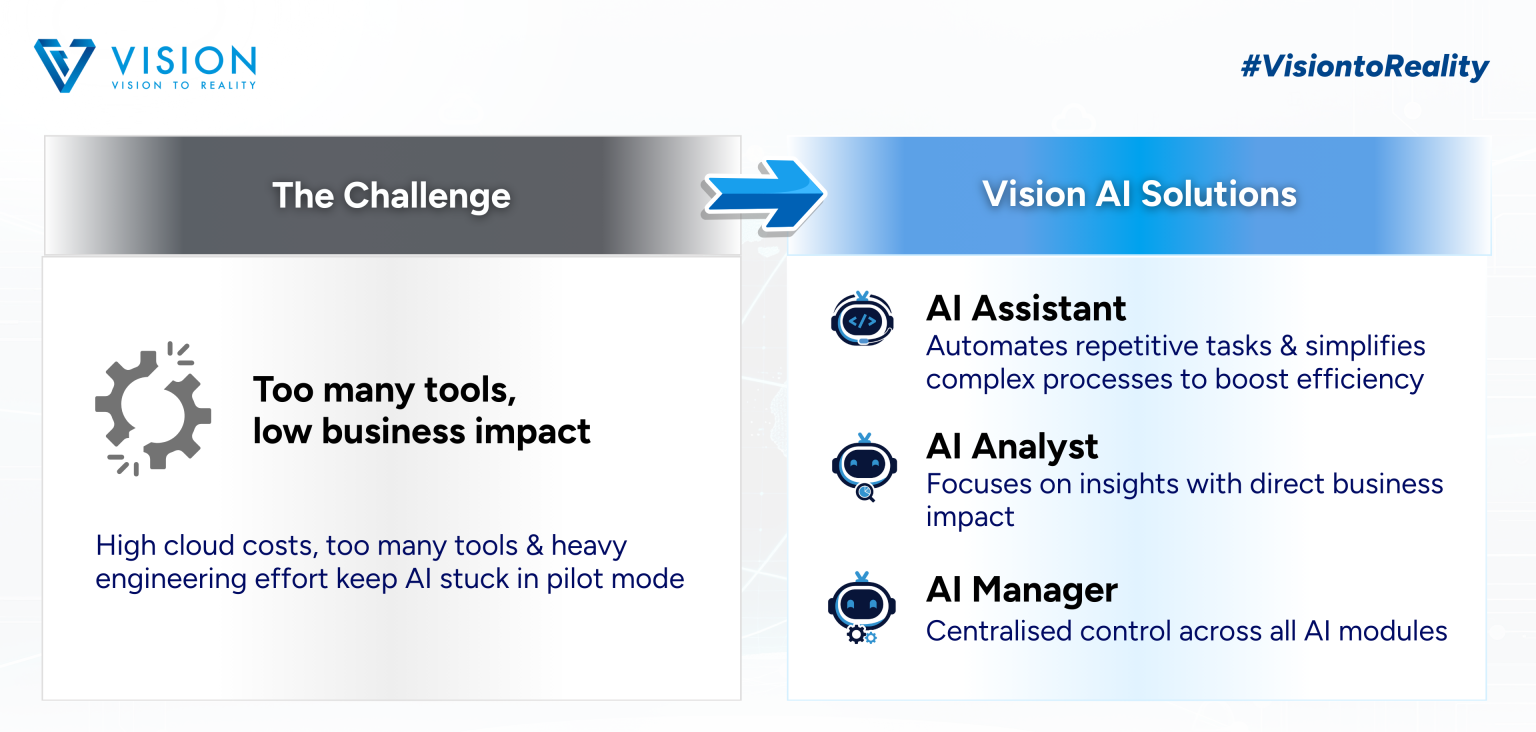
Many AI initiatives stall after proof-of-concept. Cloud bills grow, tools multiply, and engineering effort increases, yet business impact remains limited. Leaders begin to question whether AI is worth scaling.
This happens when AI focuses on heavy model training instead of practical workflow automation.
🌐How VisionGroup addresses this
VisionGroup prioritises workflow-level AI that delivers value quickly:
✅AI Assistant automates repetitive tasks and simplifies complex processes to boost efficiency
✅AI Analyst focuses on insights tied directly to business outcomes
✅AI Manager centralises orchestration across all AI modules
💡Why this works
By avoiding unnecessary complexity, VisionGroup reduces cost and shortens time-to-value. AI scales because it solves real problems efficiently, not because it consumes more resources. However, even the most cost-effective AI fails if people choose not to use it.
5. Teams Do Not Use the AI
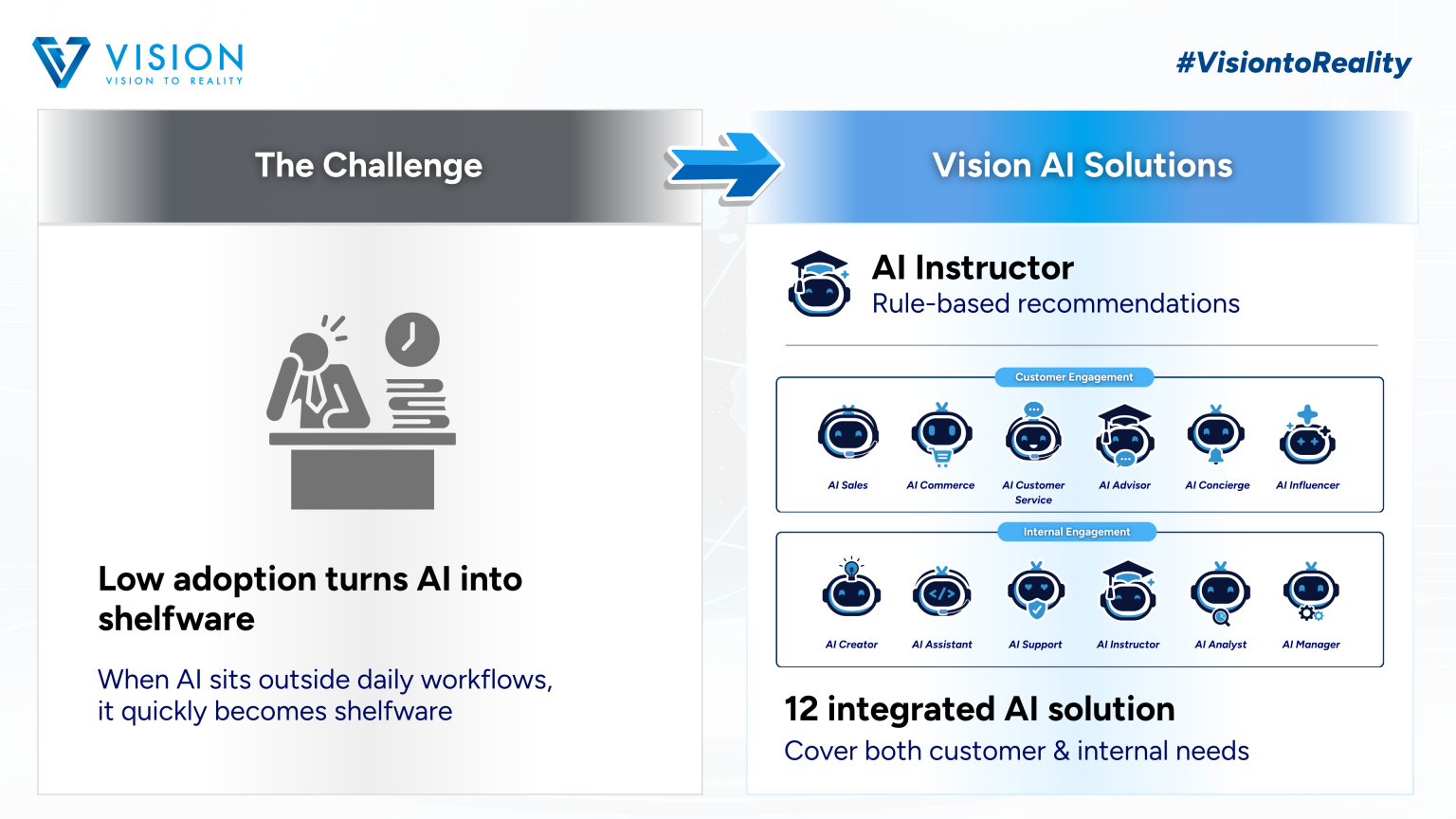
Low adoption remains one of the most underestimated AI challenges. Teams often avoid AI tools because they feel disruptive, confusing, or unreliable. When AI sits outside daily workflows, it quickly becomes shelfware. Adoption is not a technical problem, it is a design problem.
🌐How VisionGroup addresses this
VisionGroup designs AI with real users in mind:
✅AI Instructor provides scalable, on-demand training that reduces onboarding time and lowers ongoing training costs
✅VisionGroup offers 12 integrated AI solution modules designed to cover both customer engagement and internal engagement needs end-to-end.
💡Why this works
Rather than relying on a single AI to solve every problem, VisionGroup provides purpose-built modules for different functions – ranging from sales, customer service, and commerce to advisory, productivity, and internal training. This modular approach ensures each team uses AI that fits its role, without adding unnecessary system complexity.
With a complete and integrated solution set, AI becomes part of everyday workflows across the organisation, supporting both customer-facing operations and internal teams, instead of operating as a standalone tool.
Turning AI into a Practical Business Capability
AI success in 2026 will not be defined by how advanced the technology is, but by how well it fits into everyday business operations. Organisations that succeed are those that build AI to be governed, explainable, and genuinely used by their teams.
The right AI approach starts with real business problems. By focusing on data quality, trust, cost, transparency, and adoption, enterprises can avoid the common pitfalls that cause many AI initiatives to stall at the pilot stage.
Through a modular approach that supports both customer engagement and internal engagement, VisionGroup helps organisations embed AI into daily workflows. AI becomes a natural part of how teams work and serve customers, driving real business impact in 2026 and beyond.