


In today’s digital economy, businesses are no longer limited by geography. Companies can reach customers across multiple countries, cultures, and regions almost instantly. But while technology has made global expansion easier, one major barrier remains: language.
Customers expect brands to understand them – not just their needs, but also their language, cultural context, and communication style. Businesses that fail to localize their communication often struggle to build trust, convert enquiries into sales, and deliver consistent customer experiences.
Localization is no longer just a marketing tactic. It has become a key driver of global market success. Read the full article below to learn why localization matters in global growth!
Global Markets Come With Local Expectations

As businesses expand internationally, they often assume that a single language, typically English, will be sufficient for customer engagement. In reality, customers strongly prefer interacting in their native language.
Research consistently shows that customers are more likely to purchase products, engage with brands, and trust services when information is provided in a language they fully understand.
When companies fail to localize their communication, they unintentionally create friction in the customer journey. What might seem like a small language gap can quickly become a barrier that discourages engagement and reduces conversions.
This is reflected in findings from the European Commission’s ELAN study, which reported that 11% of SMEs surveyed had lost contracts due to a lack of language skills. The same study also found that some companies lost contracts worth more than €1 million, with estimated losses across surveyed firms ranging from €8 million to €25 million.
These findings show that localization is not simply a communication enhancement. In global markets, language capability can directly influence trust, conversion, and a company’s ability to compete across borders.
The Hidden Cost of Language Barriers

Many organizations underestimate how much language limitations affect their operations. Without proper localization, businesses commonly face several challenges.
1️⃣Reduced Customer Engagement
Customers feel more comfortable asking questions, exploring products, and making decisions when communication happens in their native language. If support, product descriptions, or enquiry responses are only available in one language, potential customers may disengage before completing their journey.
2️⃣Lost Sales Opportunities
Language confusion often leads to abandoned enquiries. Customers who cannot clearly understand product information, pricing details, or service responses may choose to walk away rather than risk making the wrong purchase decision. Over time, these missed opportunities translate into lost revenue and reduced conversion rates.
3️⃣Operational Bottlenecks
To overcome language gaps, many companies rely on manual solutions such as hiring multilingual staff or translating content manually. While this approach works initially, it becomes increasingly inefficient as the business grows. Manual translation slows response times, increases operational costs, and introduces inconsistencies in communication.
4️⃣Inconsistent Customer Experience Across Markets
Providing consistent customer support across different regions is difficult when language capabilities are limited. Customers in one country may receive fast responses and clear information, while others experience delays or misunderstandings due to translation limitations. This inconsistency can weaken brand perception and reduce customer satisfaction.
Vision’s AI-Powered Multilingual Solution
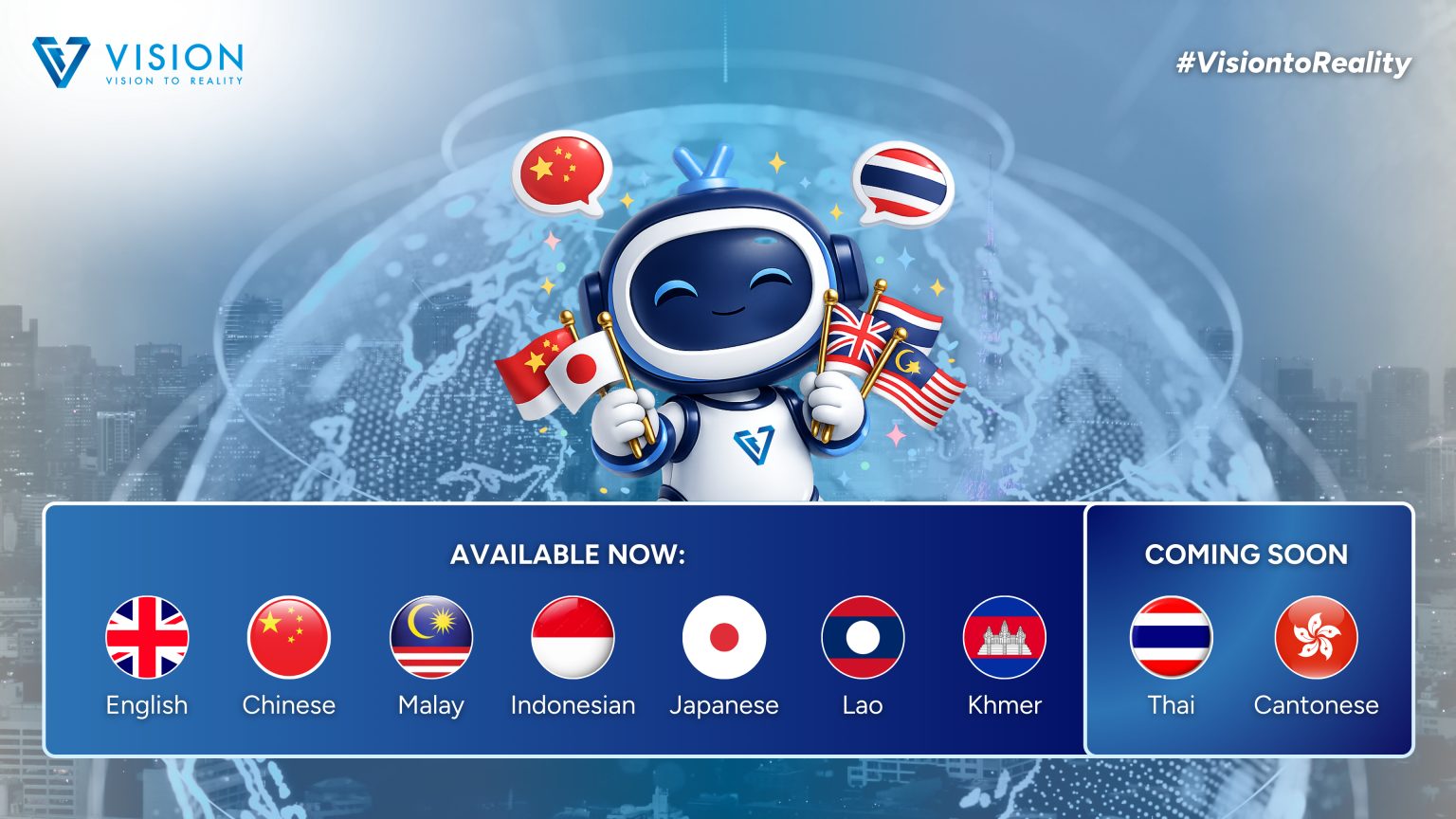
Vision helps businesses overcome language barriers through AI-powered multilingual engagement solutions.
Our AI systems are designed to understand and communicate naturally across multiple languages, enabling businesses to interact with customers in their preferred language across various digital channels.
By integrating multilingual AI into customer engagement workflows, companies can improve responsiveness, reduce translation overhead, and scale their services across different markets.
Vision AI currently supports multiple languages to help businesses serve diverse regional markets.
🔠Available languages:
Vision currently supports English, Chinese, Malay, Indonesian, Japanese, Lao, and Khmer, with additional languages continuously being added to expand regional coverage. Thai and Cantonese are coming soon.
Businesses that invest in localization can benefit from:
👥Higher customer trust and engagement
⚡Faster response times to enquiries
📈Improved conversion rates
🌍Greater scalability across international markets
As companies expand regionally or globally, localization becomes a foundational element of sustainable growth.
Scaling Customer Engagement Without Language Limits
Businesses that succeed globally are those that remove barriers between themselves and their customers. Language should never be the reason a customer cannot access information, ask questions, or complete a purchase.
By combining localization strategies with AI-powered multilingual engagement, companies can create a customer experience that feels natural, responsive, and accessible – regardless of where their customers are located.
Localization is no longer optional. It is becoming a critical capability for companies looking to grow and compete in global markets. Let’s break language barriers and connect with more customers through multilingual engagement with VisionGroup!