

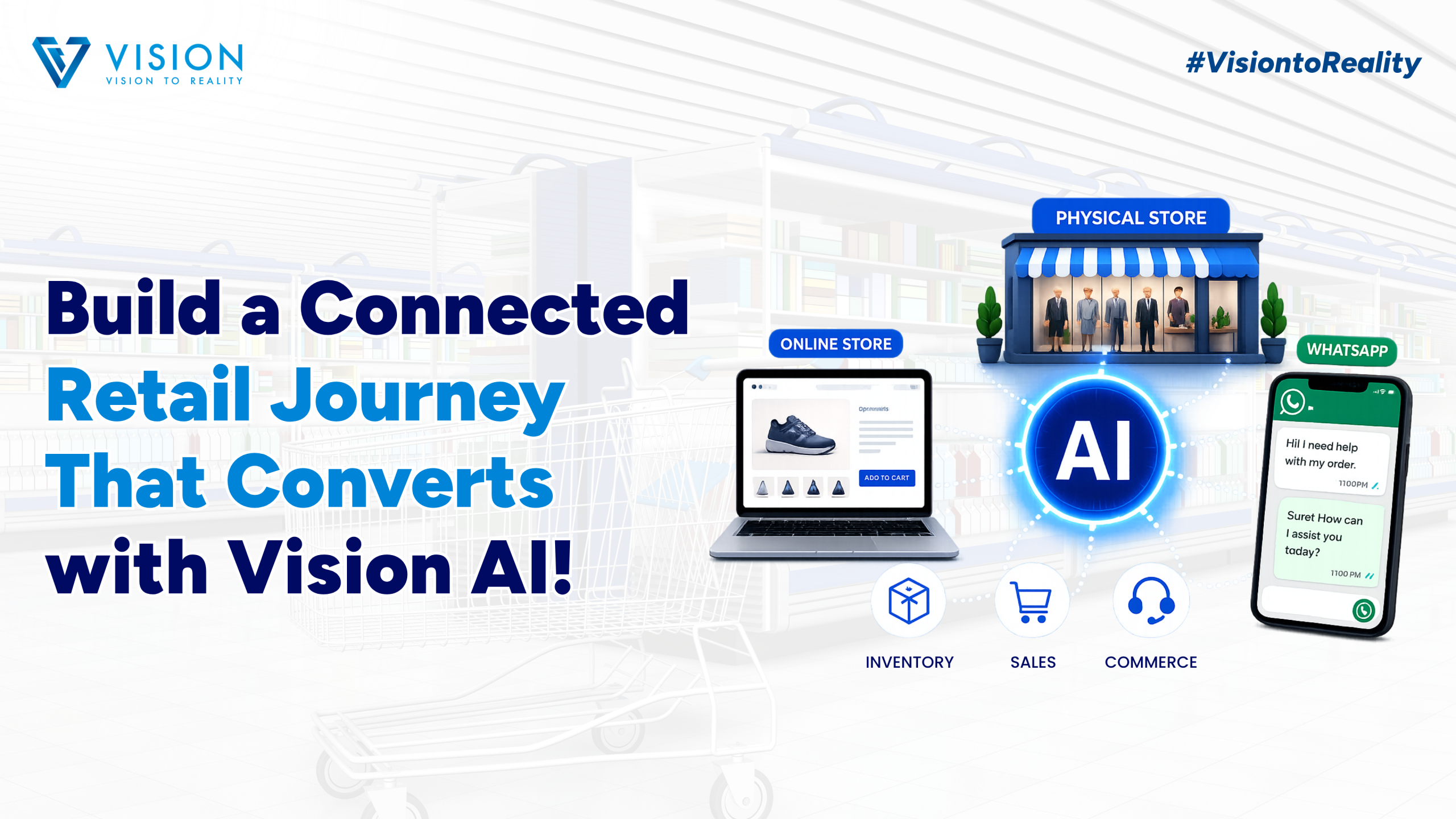
Retail brands today are everywhere – in stores, websites, WhatsApp, and social media. On paper, more channels should create more chances to sell. However, that is not always the case.
Customers are already browsing, asking questions, and engaging across many touchpoints. Yet, conversions remain inconsistent because the journey is often disconnected. As a result, the customer experience breaks at different stages, even when demand is already there.
73% of shoppers use multiple channels and expect consistency (Harvard Business Review, 2024). Retailers using AI are also seeing up to 9.5% higher revenue growth (Aberdeen Group, 2024).
The shift is clear. Retail today requires a connected system across digital and physical channels. Read below to understand where sales are lost and how to fix it.
👉Get your FREE AI Cheatsheet for Retail Business!
Identify gaps, connect your channels, and convert more customers.
The Reality of O2O Retail: Customers Don’t Buy in One Step
Customers explore products, prices, and promotions online.
They visit physically to see, try, or validate the product.
They ask later about stock, sizing, delivery, or promotions.
They may disappear for days before coming back to decide.
Without timely support, customers may drop off before making a purchase.
Customers don’t buy in one step anymore. Instead, they move between online and offline channels before making a decision. For example, they may visit a store and ask follow-up questions later on WhatsApp.
They may also browse online before coming down physically to validate a product. In some cases, they enquire first, disappear for a few days, and return when they are ready. This behaviour is normal in today’s retail journey.
However, the problem starts when businesses treat each interaction as separate. As a result, customers need to repeat themselves, receive inconsistent responses, and lose momentum before they buy.
Where Sales are Actually Lost in the Customer Journey
Responses are slow or inconsistent, causing customers to lose interest before the conversation properly begins.
Conversations remain reactive instead of guided, leaving customers unsure about the next step.
Warm leads are not re-engaged, and potential buyers are forgotten before they are ready to purchase.
Different outlets or staff provide different experiences, making service quality dependent on individuals.
Data is available but not used effectively, making it difficult to identify where customers drop off.
Sales are rarely lost in one obvious moment. More often, they are lost through small gaps across the customer journey.
At the enquiry stage, slow or inconsistent responses can cause customers to lose interest early. During engagement, conversations may become reactive instead of guided. As a result, customers are left without a clear next step.
The follow-up stage creates another major gap because warm leads are not always re-engaged. In addition, different outlets or staff may provide different experiences, which affects trust and consistency.
Finally, data may already be available, but it is not always used well enough to show where customers are dropping off.
A Practical Approach to Fixing the Customer Journey
Improving the customer journey starts with clarity. First, businesses need to identify where customers drop off by mapping the journey from first enquiry to final purchase.
After that, the gaps should be fixed in phases, so implementation feels practical and easier to manage. Then, the right tools can be introduced to support existing workflows instead of disrupting them.
This is where the Vision AI Success Blueprint can help. It gives businesses a structured way to identify journey gaps, improve processes step by step, and support daily operations with the right tools.
3 Pillars That Help Businesses Turn AI Into Measurable Impact
AI Impact Matrix
A decision-making tool for evaluating and prioritising AI investments based on business relevance, feasibility, and expected value.
AI Transformation Framework
A methodology for implementing AI in a way that supports measurable ROI, stronger adoption, and clearer execution.
AI Growth Insights
A business intelligence approach that turns data into actionable insights, helping leaders make better decisions as adoption matures.
AI Impact Matrix
A decision-making tool for evaluating and prioritising AI investments based on business relevance, feasibility, and expected value.
AI Transformation Framework
A methodology for implementing AI in a way that supports measurable ROI, stronger adoption, and clearer execution.
AI Growth Insights
A business intelligence approach that turns data into actionable insights, helping leaders make better decisions as adoption matures.
Instead of guessing what to fix, businesses can see where sales are being lost and take action in a more scalable way. The goal is simple: build a connected customer journey that turns demand into actual sales.
How AI Helps Connect Retail Channels
 AI Sales
 AI Commerce
 AI Customer Service
 AI Instructor
Creating a connected journey requires more than effort. It requires a system. AI Sales ensures enquiries are handled with fast and consistent responses, helping guide customers toward a decision and improving conversion rates.
AI Commerce allows customers to browse products, receive recommendations, and build their cart directly within chat, creating a smoother and faster purchase experience.
AI Customer Service provides reliable and consistent support after purchase, strengthening trust and increasing customer retention.
AI Instructor helps standardise training and processes, ensuring teams deliver consistent experiences across all outlets.
Together, these solutions form a connected system that supports the full customer journey, from first interaction to post-purchase engagement.
Start Fixing the Journey, Not Just the Channels
Being present across multiple channels is no longer enough. Without connection, more channels simply create more gaps where sales can be lost.
The real opportunity lies in fixing the customer journey, so every enquiry, interaction, and follow-up works together to drive conversion.
If you are exploring how AI can support your retail business operations, the first step is understanding which solutions fit your workflow and goals. Reach out to us at psg.visiongroup.co/retail to start the conversation and build a more connected, conversion-driven retail experience!