

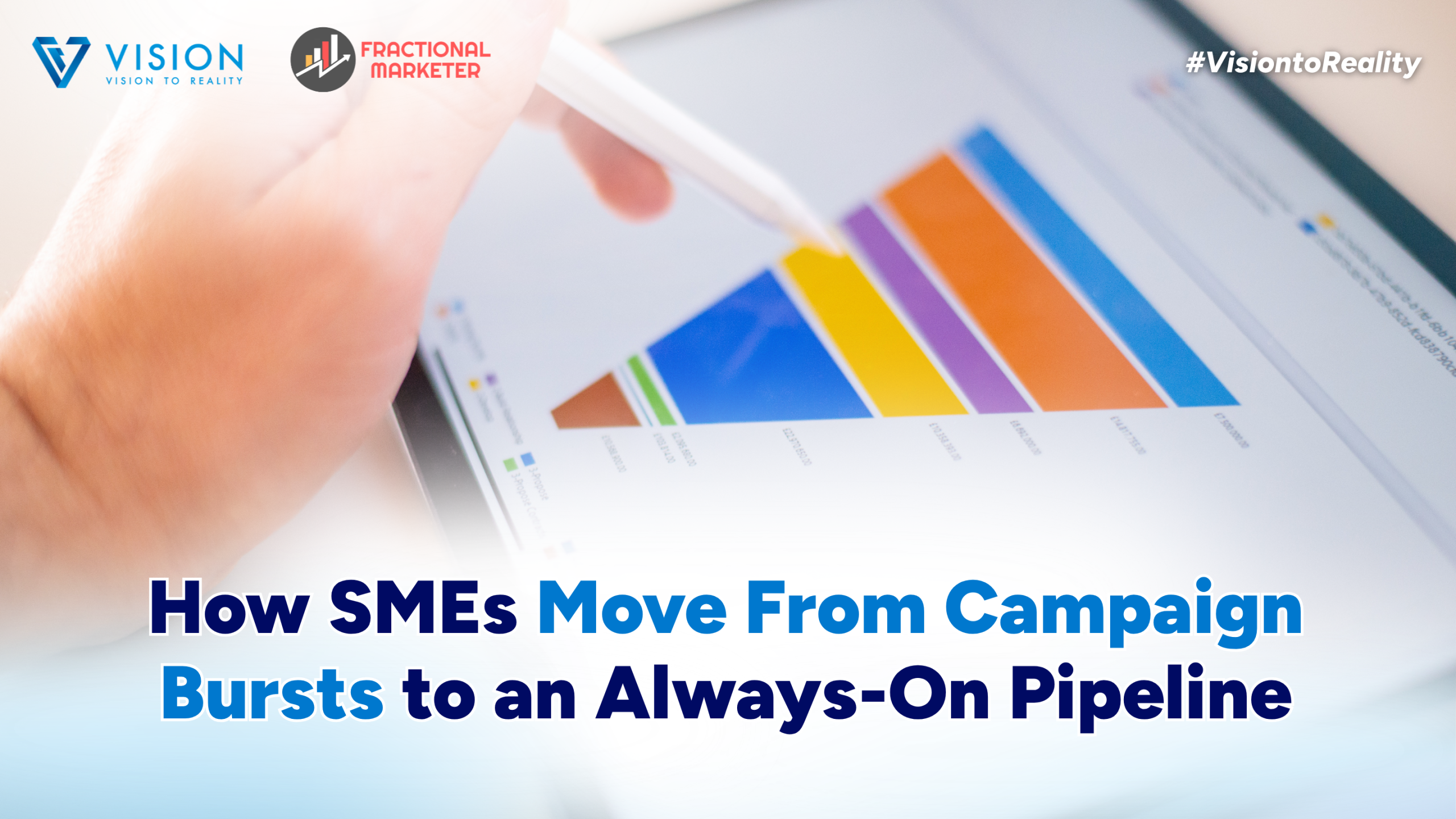
Marketing activity within SMEs often follows a familiar pattern. SMEs launch campaigns with clear intent, whether to support an event, promote an offering, or drive short-term demand. During these periods, activity increases, teams generate leads, and the funnel shows visible momentum.
These bursts of activity often create a sense of progress, especially when teams measure performance within short campaign windows. Teams align around specific goals, activate channels simultaneously, and concentrate results within a defined period.
However, once a campaign ends, momentum rarely continues. Outreach slows, teams become inconsistent with follow-ups, and pipeline begins to taper off. Over time, this creates a cycle of peaks and gaps rather than a steady progression of growth.
Without a consistent underlying system, each new campaign effectively starts from a reset position, and teams must repeatedly rebuild visibility and engagement.
The Structural Limitation of Campaign-Led Marketing
Campaigns drive attention and generate initial interest, but they do not sustain pipeline on their own. When SMEs rely primarily on campaigns, several structural limitations emerge:
Campaign-Driven Lead Spikes
Lead generation concentrates within short timeframes, creating dependency on repeated campaigns instead of stable pipeline flow.
Inconsistent Follow-Up Execution
Teams struggle to maintain follow-up after campaigns, reducing conversion potential and momentum continuity.
Unstable Pipeline Forecasting
Pipeline volume fluctuates heavily, making forecasting less reliable and reducing strategic visibility.
Incomplete Lead Development
Existing leads are not fully developed before new campaigns start, leading to fragmented nurturing and missed opportunities.
This creates a system where teams continuously apply effort, but they do not always optimise for long-term outcomes.
The Shift to Always-On Growth
An always-on approach shifts SMEs from isolated campaign activity to continuous execution. Instead of running marketing as separate initiatives, SMEs build a system that runs consistently over time. In this model:
Continuous Account Identification
Teams identify and update target accounts continuously rather than only during campaigns.
Always-On Outreach
Outreach runs continuously to maintain visibility and engagement across segments.
Lead Nurturing Flow
Leads are structured and nurtured through defined stages instead of being left idle.
Follow-Up Execution
Systematic follow-ups ensure no opportunities are lost due to timing gaps.
This approach creates a more stable and predictable pipeline, where growth builds progressively instead of resetting after every campaign.
What Enables This Transition
SMEs cannot achieve this shift by simply increasing activity. They need a structured framework that connects targeting, messaging, and execution into a cohesive system.

Defined Target Segments
Clear segmentation of accounts and decision makers.
Problem-Aligned Messaging
Messaging built around real customer pain points.
Customer Journey Flow
Structured journey from first touch to conversion.
Cross-Team Ownership
Aligned execution between marketing and sales.
Marketing partners like Fractional Marketer often help SMEs build this structure so that marketing operates as a system rather than disconnected activities.
The Role of AI in Sustaining Execution
Once SMEs establish the system, consistency becomes the next challenge. This is where AI-supported execution layers, such as Vision, play a critical role.
Continuous prospect identification and enrichment ensures target accounts remain always relevant.
AI-assisted outreach maintains consistent engagement across multiple channels.
Automated follow-up sequences are triggered based on real engagement behaviour.
CRM workflows align marketing and sales with unified pipeline visibility.
Performance is continuously optimised based on pipeline contribution and real data signals.
With this in place, pipeline growth no longer depends on campaign timing or internal bandwidth. Instead, it continues to build steadily over time.
Stop Unstable Pipeline Growth!
Campaigns will continue to play an important role in marketing, especially for driving awareness and supporting specific initiatives. However, SMEs achieve better results when they build them on top of a system that ensures continuity.
In many SMEs, the real challenge is not generating interest, but sustaining momentum after initial activation. Without continuity, even strong campaigns struggle to translate into predictable long-term pipeline growth.
Sustainable growth does not come from isolated bursts of activity. It comes from consistent execution over time. Over time, this consistency becomes the key factor that separates fluctuating performance from scalable growth. For SMEs that want to stabilise and scale their pipeline, shifting to an always-on model becomes a necessary step.
Keen to know how Fractional Marketer and Vision can help? Let’s chat!